




The Texas Supreme Court recently wrapped up the 2025 part of its 2025-26 term, and based on raw opinion numbers, the Court’s pace slightly lags its most recent prior terms. In this post, we’ll walk through those numbers, how they compare to the previous two terms, and discuss some other notables we’ve seen so far and expect to come this term.
Opinion counts at the end of 2025
As of December 31, 2025, the Court issued a total of 19 opinions. That includes merits opinions (what we categorize as dispositions by the full Court) and non-merits opinions (in which a Justice either concurred or dissented from the Court’s denial to hear a case).
Those 19 opinions (counting consolidated cases once) consist of 4 majority opinions, 7 per curiam opinions, 1 concurring opinion, and 7 non-merits opinions. Here’s how those numbers compare to the two prior terms around this time:
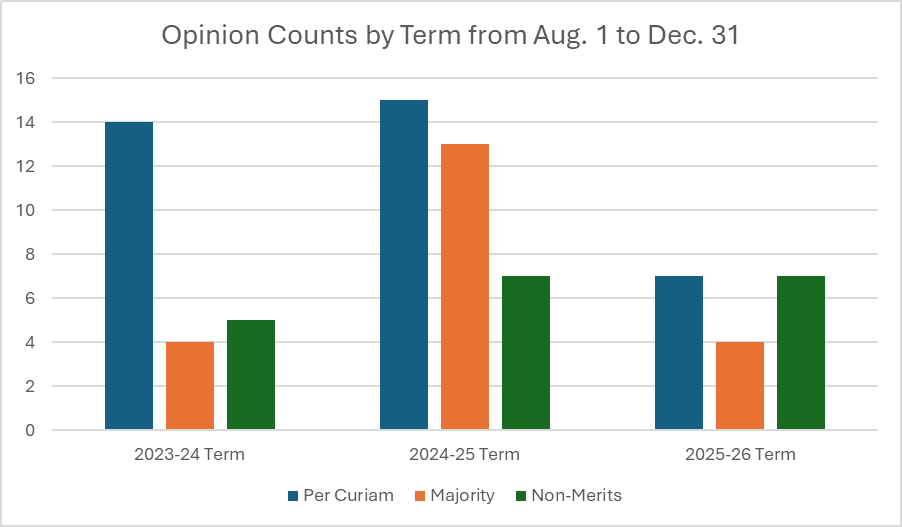
At first glance, there is relatively lower output from the Court so far this term, at least with respect to merits opinions. But a couple pieces of context are worth noting. First, the unusually high number of merits opinions from the 2024-25 term, in which the Court issued 20 opinions in the month of December alone, is largely explained by the constitutionally mandated retirement of former Chief Justice Hecht. There was no such forced retirement this year, so there was no concomitant push to get opinions out before a Justice’s departure in the New Year. Second, 4 of the 14 per curiam opinions in 2023 were published on September 1, the day the new term began, so those were cases that had actually been resolved in the 2022-23 term and likely pushed out during the August conference. Interestingly, the number of non-merits opinions has not fallen at all; it continues at a record clip, which continues the upward trend at the Court of separate writings. Third, just after the New Year, on January 9, 2026, the Court issued three more per curiam opinions, so the Court is not far from where it usually is around this time of year.
Representation
We’ve also kept track of which courts of appeals, counties, and subject matters have been most represented at the Court in cases in which the Justices are writing. While it’s difficult to extrapolate much from 19 cases, they generally comport with trends we’ve seen from prior terms:
- The Fourteenth Court of Appeals has made the most appearances in merits and non-merits opinions (5), followed by the Third Court of Appeals (4), both of which are usually in the top three most represented appellate courts at SCOTX.
- The most represented county is Harris, which is unsurprising since it is the largest county by population within the jurisdiction of the Fourteenth Court of Appeals. Harris County was also the most represented county at the Court the past two terms.
- And the most common subject matter the Court addressed in 2025 has been appellate procedure (3), followed by civil procedure (2), elections (2), family (2), and immunity (2). The largest subject-matter categories are consistent with prior terms, too, in which procedural issues, both civil and appellate, take up a large portion of the Court’s docket.
Timing
We’ve also recorded opinion-issuance timing, tracking how much time lapses between petition filing, oral argument, and the issuance of opinions.
- For merits and non-merits opinions, the average time from filing the petition for review to issuance of the Court’s opinion this term has been ~414 days, which is 95 days shorter than last term’s average (~509 days) and 84 days shorter than the term before that (~498 days).
- For merits opinions only, the average time from petition filing to opinion issuance this term has been ~437 days.
- For argued cases, the average time from oral argument to opinion issuance has been ~65 days. That’s fast. For context, the average time last term was 141 days, and 138 days for the term before that. But we expect that number to increase as the Court begins to write more opinions and continue hearing oral arguments.
Notables from 2025
From the relatively few opinions we have from the Court’s 2025-26 term, there are a couple things we think worth noting.
First, one notable feature of the per curiam opinion in 25-0641, In re Paxton, is that Justice Bland issued a separate concurring opinion. This is only the second time we can remember in recent history that a Justice wrote separately from a per curiam. (The other time was 23-0010, Walker v. Baptist St. Anthony’s Hospital, another concurrence by Justice Bland to a per curiam.) While such opinions are exceedingly rare, they are nevertheless consistent with the upward trend of separate opinions at the Court that we mentioned earlier. Perhaps we’ll see more Justices concurring or dissenting from per curiam dispositions in the future, giving us more insight into the voting patterns for those types of error-correction cases.
Second, we count three mandamus cases this term in which the Court issued a per curiam opinion without calling for briefs on the merits: 24-1073, In re Madison; 25-0641, In re Paxton; and 25-1107, In re Smith. That the Court resolved In re Smith without full merits briefing is unsurprising given its emergency posture. But In re Madison and In re Paxton did not appear particularly urgent; those mandamus petitions were filed in December 2024 and July 2025, respectively. So it’s possible the Court used those cases as a proof of concept for per curiam opinions going forward with its new petition procedures. Granted, with mandamus petitions, the Court does not usually run into the problem of combined briefing on grant worthiness and the merits. Why the Court should grant the mandamus petition is baked into the mandamus standard. But it’s still common practice for the Court to order merits briefing for mandamus petitions it wants to resolve. That the Court did not do so for these pair of cases may signal how the Court will handle per curiams now with the new petition rules.
Looking ahead
As of the date of this post, the Court has issued 24 opinions this term, so there is obviously much more to expect in 2026. Indeed, of the 41 cases argued from September 1, 2025, through December 31, 2025, 36 still await opinions. There is also a considerable amount of room remaining on the Court’s oral argument calendar, although the time to fill those slots is running out. As of now, 14 cases have been scheduled for argument in the upcoming sittings (counting consolidated cases once). Notably, half of those future oral-argument settings were based on petition grants from today, January 16. For comparison, the Court heard oral argument in more than 20 cases from January 1, 2025, through March 31, 2025. Only time will tell what the overall numbers will look like at the end of the term.
Aside from opinions and oral arguments, we’re keeping an eye out for a few other developments this term, including:
- Timing-wise, what can practitioners and clients expect at the Court in light of the new petition procedures? First, we expect less leeway when it comes to extending merits briefing deadlines. Since the Court will schedule oral argument after granting the petition (rather than after receiving merits briefing), it will likely not want to bump briefing schedules in a way that will affect oral-argument settings. Second, we expect the Court to take more time to act on petitions for review given their increased length, but we also anticipate the overall time from filing to judgment to decrease, and perhaps even substantially depending on how the Court handles setting oral arguments after granting the petition.
- How is the Court going to handle per curiam opinions in light of the new petition procedure? The prior procedure—requesting briefs on the merits before granting the petition—has been particularly suitable for per curiams. The Court had the benefit of full briefing without the burden of oral argument. But now that the Court will be granting petitions before ordering briefs on the merits, it is unclear whether the Court will switch to relying on just the petition-stage briefing (plus the COA briefing) or continue ordering briefs on the merits but not setting those cases for oral argument. If the latter, predicting whether the Court will issue a per curiam opinion for any particular case should be relatively easy. But if the former, the process will be just as shrouded in mystery as before.
- Will the number of certified questions decrease? We have no reason to think a change in leadership on the Court will substantially affect the number of certified questions the Court receives or the Court’s general policy of accepting them. But there have been a couple subtle signals this past year that the tide may turn. For example, a couple months ago, in Stanford v. Brandon Nursing and Rehabilitation Center, LLC, No. 24-60509, Judge Andrew Oldham wrote a lengthy dissenting opinion challenging the Fifth Circuit’s standard for certifying questions as “theoretically bankrupt” and suggesting that the Circuit ought to certify fewer questions to state supreme courts. Then, in June 2025, Justice James Sullivan dissented in Torres v. City of San Antonio, No. 24-0714, writing that he would decline to accept the Fifth Circuit’s certified question concerning a new Texas constitutional provision. These are, to be sure, solo dissenting opinions, but they are heretofore unexpressed views that could possibly gain traction in the future among their colleagues.
- Finally, will the Court publish a new internal operating procedure? As of now, the only publicly available internal operating procedure is one that was published back in 2006, which is somewhat outdated and, in a couple minor respects, inconsistent with current practice. The need for an updated, publicly available IOP has taken on a new urgency now with the new petition procedures in effect.
While 2025 has come to an end, we’re just getting started. We will return with a more robust opinion count from the 2025-26 term in July, and until then will provide updates and insights on much more.
/Passle/678abaae4818a4de3a652a62/SearchServiceImages/2026-08-12-21-32-53-009-6a7ce685041f696e4cb27312.jpg)
/Passle/678abaae4818a4de3a652a62/SearchServiceImages/2026-09-24-16-08-28-399-6ab54afc480f2289e9a3c3e1.jpg)

/Passle/678abaae4818a4de3a652a62/SearchServiceImages/2026-08-31-02-23-38-311-6a94e5aa7f78a11931bf47f1.jpg)